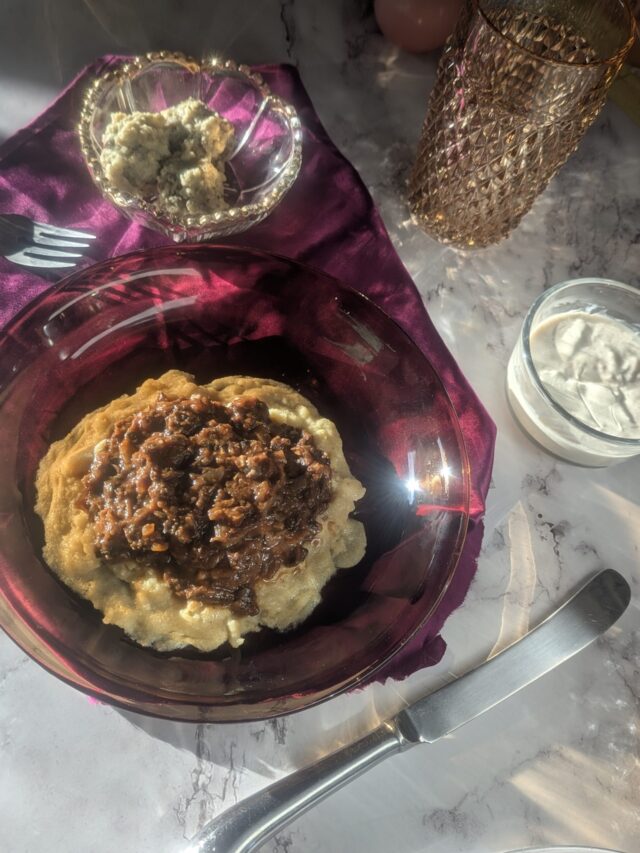

Pureed (IDDSI Level 4)

Completely smooth foods/extremely thick liquids with no lumps that hold their shape on a spoon and don’t require chewing.
Congee is a dish built on patience and comfort; a slow-cooked rice porridge that has sustained much of East and Southeast Asia for centuries. Its name changes from region to region: juk in Korea, zhou in China, okayu in Japan. But the principle remains constant: rice simmered in water or broth until it breaks down completely, transforming into a creamy, soothing base for almost anything.
Turkey congee is a natural adaptation, often appearing in home kitchens after holidays or large meals when there’s stock made from a roasted bird and enough leftovers to flavor a new dish. The mildness of the turkey pairs easily with ginger, scallion, sesame, or a drizzle of soy, but it’s just as good left plain. Gentle on the stomach and grounding in flavor.
A Texture That Invites Everyone
From a dysphagia standpoint, congee is one of the most adaptable dishes you can make. When cooked long enough, rice granules dissolve into a smooth, spoon-cohesive base that naturally meets many IDDSI criteria. For a Pureed (IDDSI Level 4) version, an immersion blender can create a fully uniform consistency; for minced & moist or soft & bite-sized levels, adjusting the liquid ratio and cooking time allows precise control over thickness and grain breakdown.
To make it safer and more consistent across levels:
- Cook low and slow. Use plenty of liquid (typically 1 part rice to 8–10 parts water or broth) and stir occasionally so the starch releases evenly.
- Blend or mash to test the texture. For pureed levels, the finished congee should slide cleanly from a spoon without liquid separation.
- Add moisture at serving temperature. Congee thickens as it cools; a splash of warm broth can return it to level.
Because it reheats well, it’s also a perfect make-ahead meal for those needing dependable nutrition and comfort in one bowl.
Make this Recipe for Your IDDSI Level
As written, this recipes is at IDDSI Level 4 Pureed. This recipe can also be adapted for Level 3 Liquidized, Level 4 Pureed, Level 6 Soft and Bite Sized, and Level 7 Easy to Chew. See the adaptation instructions below or if you are printing the recipe, they will be included in the notes section.
Level 3 Liquidized (Smooth enough to drink or pour; no chewing): Follow the recipe as written and then you will need to add liquid slowly until it is flowing at the right speed; always test at time of eating using a flow test to make sure its at your level.
Level 5 Minced and Moist (Soft pieces that fit between fork prongs in a puree; minimal chewing): The rice doesn’t need to be cooked down to a full puree, but should be tested for particle size. Pulsing dried rice in a food processor before cooking can help you achieve a cohesive but not sticky texture. Be sure to check for separating liquids and drain accordingly.
Level 6 Soft and Bite Sized (Tender pieces smaller than the width of fork prongs): You will not need to cook rice down to a puree, but make sure turkey pieces are diced to be 15mm pieces or smaller and kept soft. Be sure to drain off any separate liquids.
Level 7 Easy to Chew (Foods that are soft and easily bite into pieces): This recipe can be enjoyed without any piece size restrictions and you may be able to enjoy as a more traditional mixed consistency soup as long as you don’t have airway protection difficulties.

Turkey Congee Recipe
Ingredients
Equipment
Method
- Combine rice, broth, carrot, ginger, and salt in a pot. Bring to a boil, then reduce to low heat and simmer 1 hour, stirring occasionally until rice breaks down.
- Add turkey; continue cooking 10 minutes more.
- Transfer mixture to a blender; blend until completely smooth.
- Add small amounts of warm broth as needed to reach mound-forming, non-dripping consistency.
Same Recipe, Your Texture
For Minced and Moist (IDDSI Level 5): The rice doesn’t need to be cooked down to a full puree, but should be tested for particle size. Pulsing dried rice in a food processor before cooking can help you achieve a cohesive but not sticky texture. Be sure to check for separating liquids and drain accordingly. For Soft and Bite Sized (IDDSI Level 6): You will not need to cook rice down to a puree, but make sure turkey pieces are diced to be 15mm pieces or smaller and kept soft. Be sure to drain off any separate liquids. For Easy to Chew (IDDSI Level 7): This recipe can be enjoyed without any piece size restrictions and you may be able to enjoy as a more traditional mixed consistency soup as long as you don’t have airway protection difficulties.Variations Across the Region and the Table
Nearly every culture that cooks rice has its own interpretation of congee. Chinese versions might include preserved egg or shredded chicken; Filipino arroz caldo features garlic, ginger, and a squeeze of citrus; Vietnamese cháo gà often finishes with fish sauce and fried shallots. These variations demonstrate how a single method, softening rice to a “creamed” texture creates space for endless flavor profiles.
For texture-modified diets, these flavor ideas can still be explored safely:
- Stir in pureed roasted carrots or squash for color and gentle sweetness.
- Top with smooth scallion oil or sesame puree instead of crisp garnishes to maintain consistency.
The result is deeply satisfying and safe, nourishment that doesn’t feel clinical or confined.
How do I…
Adjust the macros?
Protein: Stir in extra egg whites, pureed white beans, or collagen or unflavored whey isolate to fortify.
Fat: To increase, add toasted sesame oil, avocado puree, ghee or olive oil. To reduce, use poached turkey breast or reduced fat broth. Skip the oils and finish with a splash of rice vinegar or lemon juice instead.
Carbs: Use half rice, half quinoa or cauliflower rice to lower glycemic impact.
Make it fit my eating style?
Gluten-Free: Double check that your broth is gluten free, swap tamari or coconut aminos for soy sauce.
Dairy-Free/Vegan: Use vegetable stock, a mushroom mix, tofu or jackfruit for protein. Use miso paste or nutritional yeast to give umami depth.
Make it fit my spoons?
Use pre-cooked turkey (leftovers or deli-style roasted) and instant jasmine rice or rice porridge packets.
Combine everything in a slow cooker in the morning, no stirring required.
For puree diets, blend with store-bought turkey gravy or broth concentrate for quick flavor.
Freeze portions in single-serve containers; reheat and thin with water or broth as needed.
Use frozen minced onion and ginger cubes to skip chopping entirely.
Comfort That Translates
Congee’s simplicity is its strength. It meets the moment, whether someone is recovering from illness, managing a chronic condition, or simply needing something that feels restorative. For many, it’s the first solid meal after days of difficulty; for others, it becomes a long-term staple that provides steady warmth without worry.
Still hungry for more?
Congee’s texture also works well for protein recipes after wisdom teeth removal; explore the full set of puree recipes and guides here. Start your holiday meal with some favorite appetizers like the spinach and artichoke stuffed mushrooms or the goat cheese and fig flatbread.
Every recipe here is designed for texture sensitive eaters: from dysphagia to dental issues to picky eaters. Get recipe roundups and practical tips by joining the mailing list.