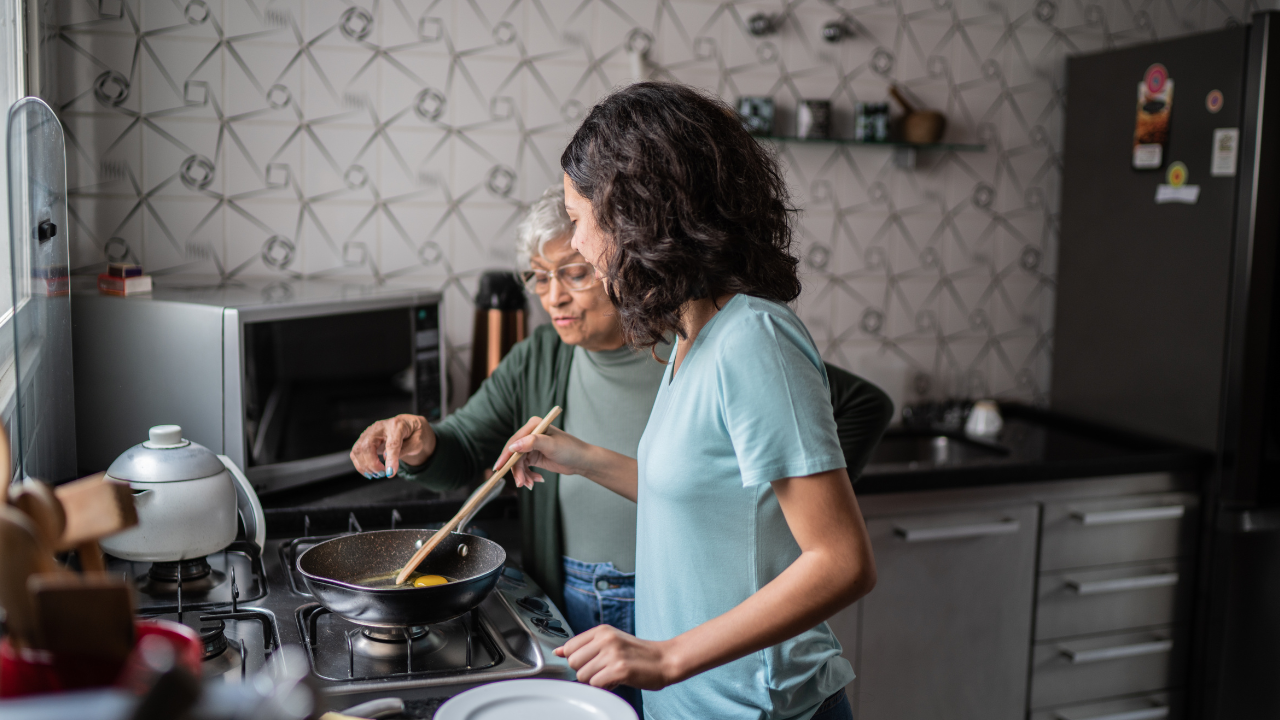
This guide was created by Amy Listermann, MS, CCC-SLP, a licensed Speech-Language Pathologist with clinical experience supporting people with dysphagia across medical, rehabilitation, and home settings. My work focuses on helping families and caregivers adapt everyday meals using IDDSI standards, so everyone at the table can eat safely without cooking separate meals. Learn more about the Same Menu approach.
Who This Guide is for:
- Caregivers, partners, and family members supporting someone with dysphagia
- Home cooks adapting their own meals for IDDSI texture levels
- Clinicians looking for caregiver-friendly education tools
Dysphagia makes eating feel unpredictable. Meals that seem soft aren’t always safe. Foods that look harmless on the plate can fall apart, dry out, or move too quickly in the mouth. But with a few simple adjustments, most everyday meals can be made dysphagia friendly without cooking a completely separate dish. This guide walks you through how to modify any meal so it’s safer, easier to manage, and still enjoyable.
What a Dysphagia Friendly Meal Needs
If you are on a dysphagia journey, a speech-language pathologist (SLP) is an invaluable clinical partner in managing meals. But most people aren’t accustomed to evaluating food the way an SLP does. For home cooks, you just need to focus on four qualities you can see, feel, and adjust:
- Moisture
Dry food is one of the biggest challenges for people with dry mouth or lower chewing endurance. Add broth, sauces, gravies, yogurts, veg or fruit purees and soft cheeses to increase moisture. - Cohesion
The food should hold together instead of crumbling or scattering. Loose or flaky textures can break apart unpredictably. Adding a binder helps the bite stay organized in the mouth. - Consistent Particle Size
Mixed or uneven textures are hard to control. Reducing to a uniform size by chopping, mashing, mincing, or pulsing in a processor until the texture matches framework. - Predictability
Each bite should behave the same way. While you can use lower level textures in higher level meals, don’t mix in higher levels or liquids with solids (see more with mixed consistencies below).
How to Modify Any Meal
These are the universal moves caregivers use in real homes every day. You can apply them to takeout, leftovers, or freshly cooked foods.
Add Moisture
The difference between a risky meal and a manageable one often comes down to features affected by moisture. When it’s too sticky, too crumbly, too chewy, foods are asking for liquids to be added to the mix. Recharge textures using liquids that fit the recipe and nutrition best: broth, sauces, blended soups, milk/yogurt/sour cream, butter/oils, even fruit or vegetable purees.
Reduce Effort
There is a lot of processing that has to happen to a bite of food from fork to stomach. We as cooks have the ability to shift some of that responsibility to us by making some simple changes in the how of our recipes. By using wet cooking techniques (explained below), or cutting pieces prior to service, we can create meals that require less endurance or coordination.
Tenderize
Moisture changes how heat moves through food. When you cook something with enough liquid, the water transfers the heat evenly and breaks down the fibers that can make some foods tough. Dry cooking pulls moisture out of the food, making the surface firmer and the interior tighten instead of relax. Instead, use wet methods like steaming, braising, stewing or pressure cooking during cooking. (You can even use some food chemistry to velvet your meats to lock in moisture, no matter the cooking method).
Change the Delivery Method
Breads/sandwiches are a high risk food item many home cooks feel they have to take off the menu. But you don’t need a brand new recipe. You can swap in “bowls” for tacos, burgers, and pizzas, or even pregel bread products so everyone enjoys the same ingredients.
Some soups are another sneaky challenge due to their mixed consistencies, that is, a food that has a flowing liquid element mixed with pieces that should be chewed. The tongue coordination and the monitoring of the liquid placement in the mouth can be overwhelming. You can transform some of your favorite soups into casseroles, or blend the soup to a uniform, no chewing needed texture.
How to Test a Meal for Safety
These simple, observable checks don’t need special tools or knowledge to help you adjust foods to serve confidently at home.
Particle Sizes
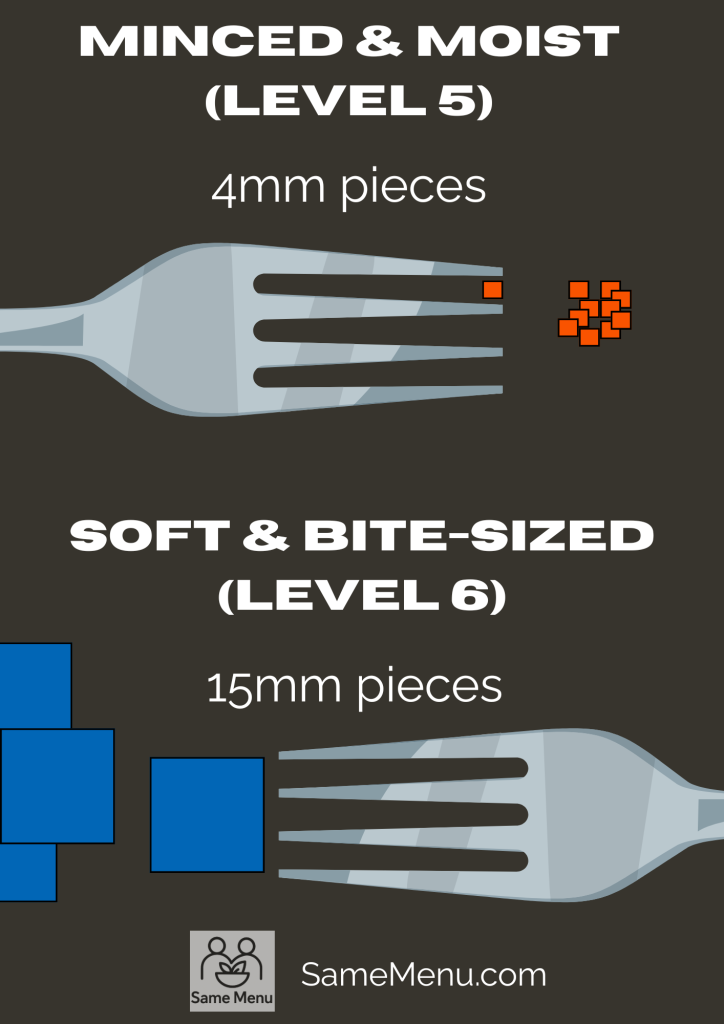
With the exception of levels 3 Liquidized and 4 Pureed, which should have no separate particles, and level 7 Easy to Chew, which has no particle limits, you will need only a standard fork to measure particle sizes.
Level 5 Minced and Moist pieces will fit between the prongs/tines of the fork.
Level 6 Soft and Bite Sized will be smaller than the width of all of the fork tines.
Fork Drip
For Liquidized, Pureed and Minced and Moist levels. Pick up a bite with a fork.
For Level 3 Liquidized, the food should drip slowly through the spaces of the fork.
For Level 4 Puree, there can be a small tail that extends below the tines, but it mainly stays in a mound on the top.
For Level 5 Minced & Moist, the bite should mound without pieces or separate liquids falling through the tines.
Spoon Tilt
For Liquidized level, scoop a bite and tilt the spoon. The food should flow off without sticking to the spoon.
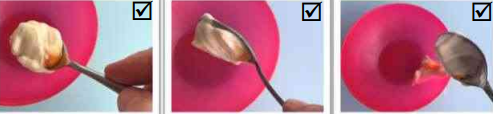
For Pureed and Minced and Moist levels. Scoop a bite and tilt the spoon. The food should fall off mostly in one piece; a thin film can be left by puree but must be able to see the spoon. A little of the minced bite may be left, but it should mostly fall as one piece vs crumbling.
Fork Pressure
For all texture-modified levels (4-EC7).
For Level 3 Liquidized, lightly pressing a fork into the surface will not leave a mark when the fork is removed.
Level 4 Puree, lightly pressing a fork into the surface will leave clear marks that remain when the fork is removed.
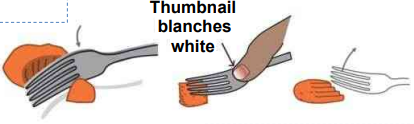
For Level 5 Minced & Moist, use the same pressure; the pieces should easy push up through the fork tines and change shape under less pressure than it takes to blanch your thumbnail.
For Level 6 Soft & Bite-Sized, press a 15mm piece with the edge of a fork, until thumbnail blanches; the piece should break apart.
For Level 7 Easy to Chew, able to use the fork edge to break off bites and pieces will change under the pressure of a thumbnail blanch.
FAQs
Do I need commercial thickeners for meals?
Not always. Many foods can be adapted with natural binders and moisture. Thickeners are useful for liquids but often unnecessary for solids.
What if the person prefers crunchy foods?
Offer the same flavor in safer forms; infuse oils with seasonings. Offer transitional foods that offer a crunchier mouth feel that changes with only moisture and minimal pressure.
How do I know when to adjust a texture down?
Base it on what the person can handle comfortably in that moment. Watch for fatigue and effort and if needed, keep the texture easier until you can get further clinical guidance.
Want the Printable, One-page Cheat Sheet?
Get the free, kitchen-ready PDF version when you sign up for monthly recipe round ups and resources.
Sources & Standards
The techniques in this guide are based on the International Dysphagia Diet Standardization Initiative (IDDSI) framework and reflect worldwide clinical practices.
© The International Dysphagia Diet Standardisation Initiative 2019 @ https://iddsi.org/standards//framework. Licensed under the CreativeCommons Attribution Sharealike 4.0 License https://creativecommons.org/licenses/by-sa/4.0/legalcode.
It does not replace medical advice, diagnosis, or treatment from a qualified healthcare professional. Always follow the diet texture level prescribed by your speech-language pathologist, physician, or care team. Do not advance diet textures without professional guidance.