If you’re following a dysphagia diet and still coughing during meals, it can feel confusing or even alarming. Many people assume coughing means the diet isn’t working or that something dangerous is happening.
In reality, coughing needs some context.
Coughing is a protective reflex
Coughing exists to protect your airway. When food, liquid, or saliva starts to move toward the wrong place (you may see it reported as “penetration” or “aspiration”), the body reacts with a strong, rapid burst of air to push it back out. This does not automatically mean harm. If you’re coughing, it usually means:
- Your throat still has good sensation
- Your body recognizes something isn’t quite right
- Your airway defenses are active
That awareness is important. It’s one of the main ways the body prevents food or liquid from entering the lungs.
Why coughing can still happen on a dysphagia diet
Texture modified diets reduce risk, but they don’t eliminate every challenge. Coughing can still occur because of:
- Timing issues – swallowing may be slightly delayed
- Fatigue – swallowing muscles tire easily, especially later in the day
- Residue – small amounts of food may stick and spill after the swallow
- Liquids behaving differently than solids – even thickened liquids can move quickly in the mouth
- Posture or pacing – eating too fast or without full support
A dysphagia diet supports safer swallowing, but swallowing itself is still a complex, coordinated process.
A quick look at what’s happening anatomically
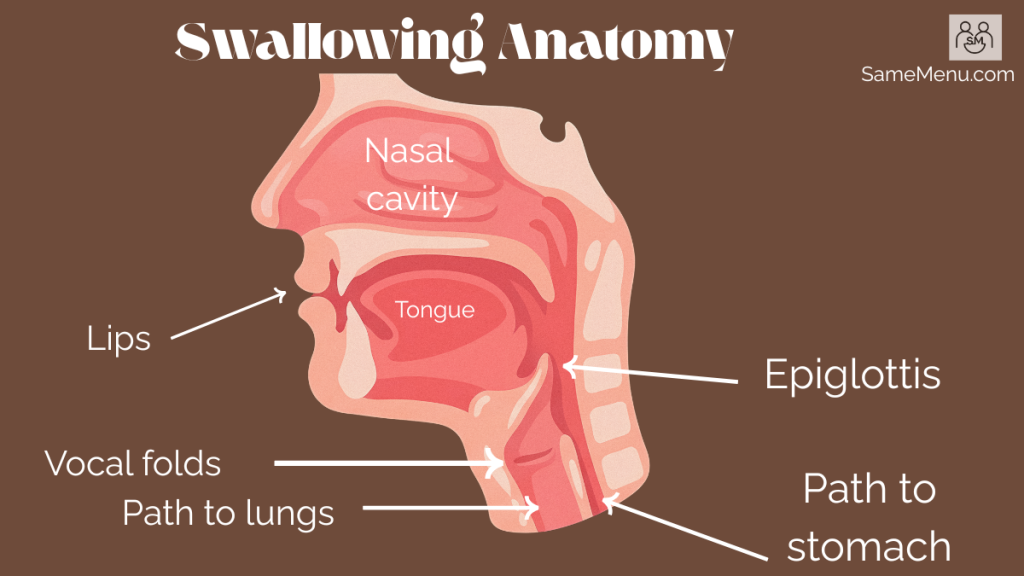
When you swallow, food should travel from your mouth into the esophagus, while the airway closes briefly to protect the lungs. This happens via the epiglottis flipping down to cover the opening, the vocal folds pressing together tightly, and the entire voice box lifting up and foward (you can feel or even watch this happening in a mirror).
Coughing can occur if:
- The airway closes a little late or incompletely
- Material touches sensitive areas near the vocal folds
- Small amounts remain after the swallow and slip downward
These are subtle coordination issues, not failures, and they’re common in people with swallowing difficulty.
When the lack of cough matters
Not everyone who coughs is aspirating, and not everyone who aspirates coughs. This is why one symptom on their own can’t tell the full story. Coughing does indicate body awareness of something going on. You may come across the term silent aspiration while researching. This refers to food or liquid entering the airway without a cough response. There are many reasons sensation can weaken or be absent, including stroke, chronic reflux, long-term irritants like smoking, radiation treatments, neurodegenerative conditions and normal aging. That’s one reason coughing is often reassuring: coughing means your body noticed the problem.
When coughing is worth paying closer attention to
Occasional coughing doesn’t automatically mean danger, there can be reasons unrelated to the swallow that trigger the body in a similar way. It may be worth discussing further if coughing is:
- Frequent or worsening
- Happening with most meals
- Accompanied by weight loss, dehydration, or fatigue
- Followed by chest congestion, fever, or repeated respiratory infections
This doesn’t mean something bad is happening, only that more information could help guide care. Ask your personal speech-language pathologist (SLP) about which if any tests are appropriate.
Why assessment matters
Swallowing tests can show:
- How food and liquid move during swallowing
- Whether material enters the airway
- Which textures are safest for you, currently
Being able to watch your body’s swallow in real time also gives your SLP the chance to try different textures, maneuvers and positions that can play to your strengths. These assessments help tailor recommendations instead of relying on guesswork or generic diet levels. The IDDSI diet texture was predominately created to ensure a shared set of language to describe, not to fully prescribe you as an individual. You and your care team will continue to develop and personalize your diet texture as your swallow function improves.
Many people start searching because they’re worried about choking or pneumonia, especially if coughing keeps happening during meals. Those concerns make sense, and the good news is that coughing itself is usually a sign the body is responding appropriately, not that something dangerous has already happened. Paying attention to patterns, staying hydrated, and getting appropriate guidance all help keep that protection working.
The takeaway
If you’re coughing while eating on a dysphagia diet:
- It does not automatically mean the diet has failed
- Coughing often means your protective reflexes are intact
- Patterns matter more than isolated moments
- Getting the right assessment can bring clarity and reassurance
Swallowing difficulty isn’t something to ignore, but it also isn’t something to panic over. With the right information and support, people eat more safely and confidently.
Looking for more information?
Want some guidance on how make any meal dysphagia friendly? Or you can head to the resources page for a full roundup of all of the educational posts in one place.
Every recipe here is designed for texture sensitive eaters: from dysphagia to dental issues to picky eaters. Get recipe roundups and practical tips by joining the mailing list.