If your child has been recommended an IDDSI food level, knowing the name of that level is only the beginning. You may have been told your child needs Level 4 Pureed, Level 5 Minced & Moist, Level 6 Soft & Bite-Sized, or Level 7 Easy to Chew foods, but how do you know whether the food you made actually meets that level?
IDDSI food testing helps caregivers check whether a prepared food has the characteristics expected for a prescribed texture level. For children, testing may include checking particle size, softness, moisture, cohesiveness and how the food behaves under pressure or on a spoon. The appropriate tests depend on the IDDSI level being prepared.
Jump to your needed level: Pureed 4 Minced & Moist 5 Soft & Bite-Sized 6 Easy to Chew 7
One of the most useful things about the International Dysphagia Diet Standardization Initiative (IDDSI) is that it doesn’t rely entirely on lists of “safe” and “unsafe” foods. Instead, IDDSI gives ways to test the physical properties of the food you’re actually serving. Two pieces of chicken aren’t necessarily equally tender. A carrot cooked for 8 minutes behaves differently from one cooked for 25 minutes. Mac and cheese that’s creamy when it leaves the stove may become considerably firmer as it cools.
As a speech-language pathologist with 10 years experience in commercial cooking, this is the part of IDDSI I want parents and caregivers to understand: Don’t just look for food lists, learn how to test the food. The appropriate food level itself should come from your child’s feeding and swallowing team. Once you have that recommendation, however, you can learn how to check whether the foods you’re preparing actually meet it.
The Main IDDSI Food Tests
You don’t need laboratory equipment to test these texture-modified foods. IDDSI intentionally developed tests that can be performed using ordinary items such as a fork and spoon. Depending on the IDDSI level, you may need to use several different tests. The important ones for parents preparing food include:
the Fork Drip Test
the Spoon Tilt Test
the Particle Size Test
the Fork Pressure Test
These test are checking for properties such as moisture, cohesiveness and separate thin liquids. Let’s go through each of them with more detail.
The IDDSI Fork Drip Test
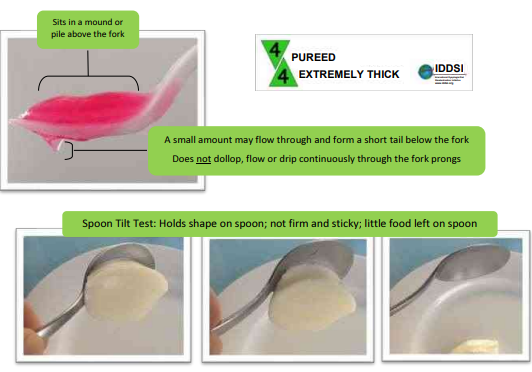
The Fork Drip Test helps assess that foods are thick and cohesive enough. This is necessary for Level 4 Pureed and Level 5 Minced & Moist foods.
To run this test, place a sample of the food on a standard dinner fork. The bite should sit in a mound or pile above the fork and not continuously drip or flow through the fork prongs (a small “tail” can slowly extend through the fork prongs).
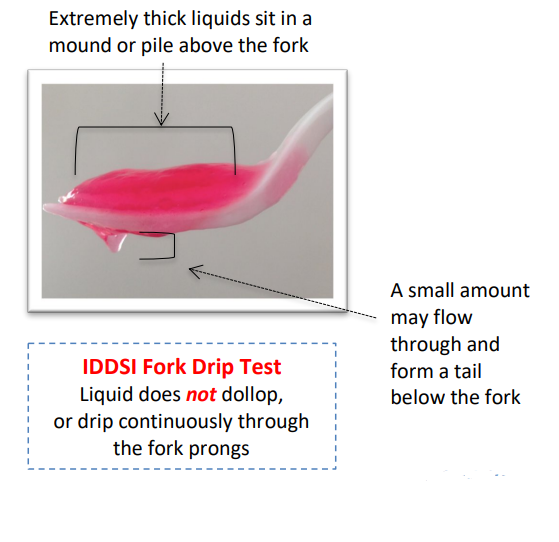
But for both of these levels, passing the Fork Drip Test isn’t enough by itself. We also want to know whether the food is too sticky. That’s where the Spoon Tilt Test comes in.
The IDDSI Spoon Tilt Test
The Spoon Tilt Test catches a problem that’s easy to miss by simply looking at a puree or mince. A food can be smooth and thick enough and still be too sticky.
Take a spoonful of the food and tilt the spoon. The food should slide off together as a bite when the spoon is tilted or lightly flicked. There should not be thick film stuck to the spoon.
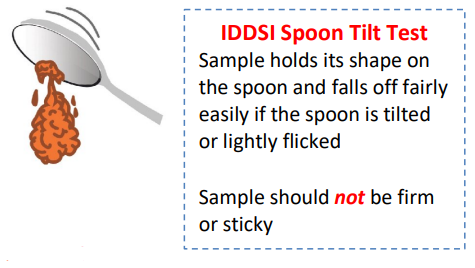
Why does that matter? We care about how it behaves while your child is trying to move it through the mouth and swallow it. A thick spoonful of peanut butter, for example, is certainly smooth and won’t drip through a fork, but that doesn’t make a spoonful of peanut butter an appropriate puree.
As we move up the IDDSI texture ladder, we also begin to introduce particles and need a way to measure their sizes. Levels 5 and 6 require a particle size test.
The IDDSI Particle Size Test
Depending on whether your care team recommends Minced & Moist or Soft & Bite-Sized, you will have a maximum size for the individual pieces. For convenience, IDDSI offers measurements that can be checked using just a fork. It is important to be thorough when checking for piece size throughout the serving and removing and reprocessing any pieces that do not pass this test.
Children Have Different IDDSI Size Requirements
This is an important detail that can easily get missed when you’re searching online for dysphagia diets. IDDSI particle and piece-size requirements are smaller for children than for adults, due to their smaller swallowing anatomy.
For children:
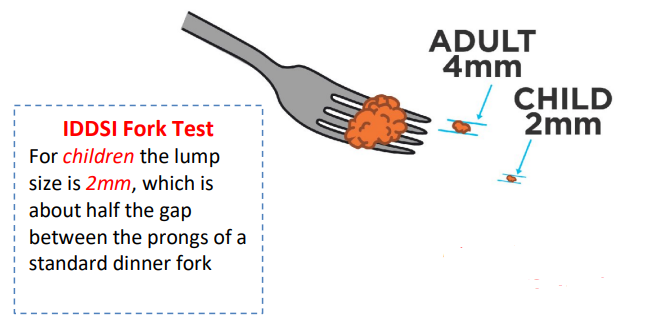
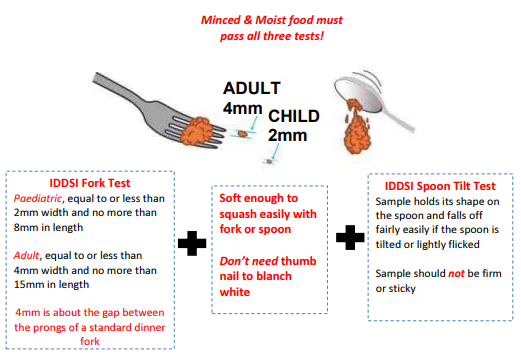
Level 5 Minced & Moist: particles should generally be no larger than 2 mm.
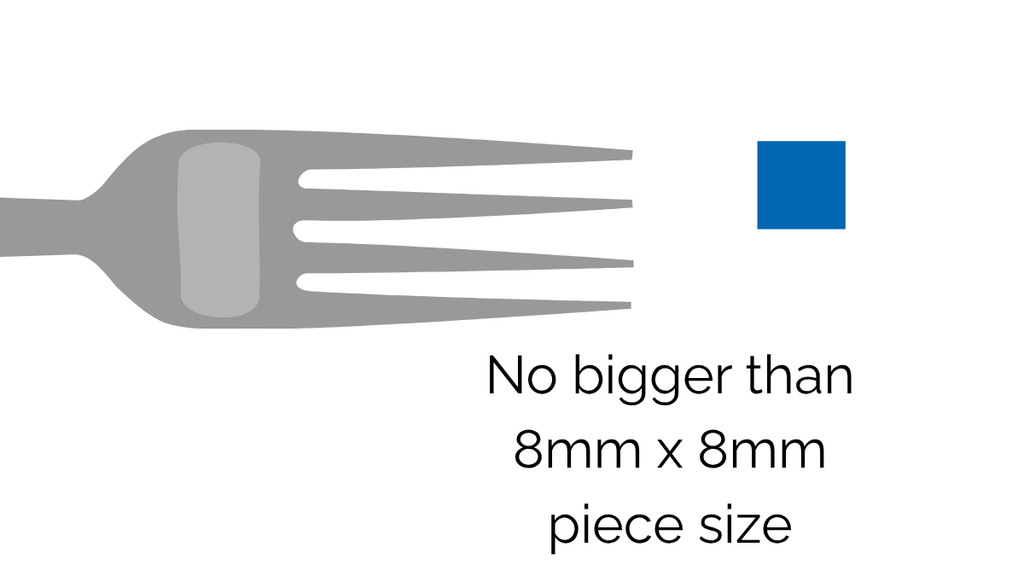
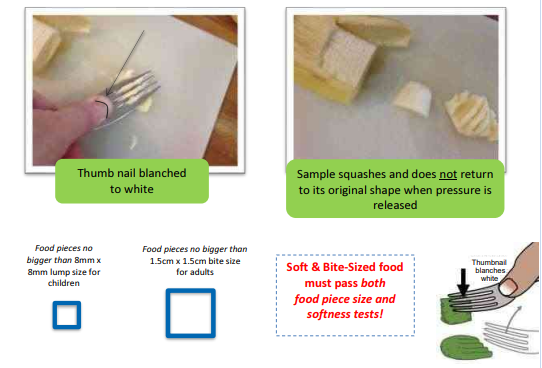
Level 6 Soft & Bite-Sized: pieces should be no larger than 8 mm x 8 mm, or half of the width across fork tines.
For comparison, the adult limits are 4mm for minced and moist and 15mm for soft & bite sized. But size is not the only aspect of the pieces in a texture-modified diet; the softness of the particles matters when deciding if a food is appropriate to serve to your child.
The IDDSI Fork Pressure Test
The final testing method of pressure will be important for Level 5 Minced & Moist, Level 6 Soft and Bite-Sized, as well as Level 7 Easy to Chew. How tender a food is can be hard to judge, but there are some guidelines, informed by the skills IDDSI determined necessary for each level, to help.
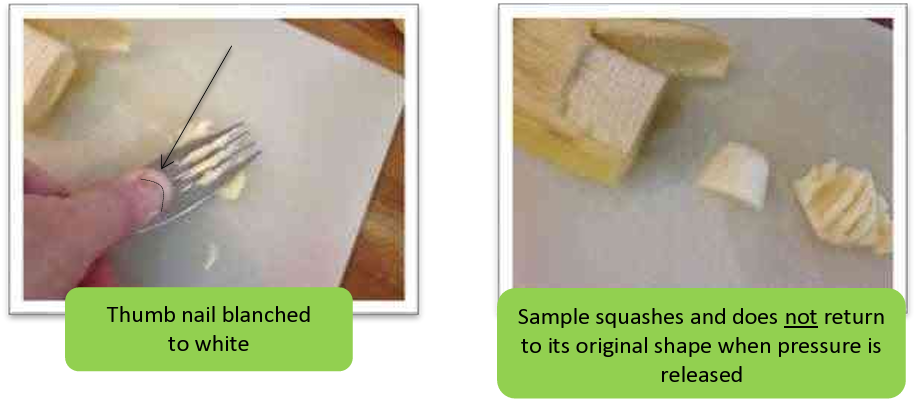
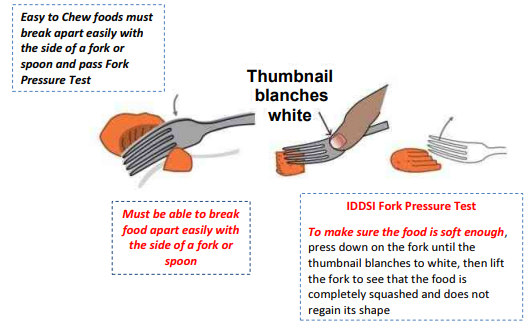
For any of these levels, you will take a small amount of the food and press down with your fork. For level 5, the particles should squash easily. To determine whether the food is genuinely soft enough to be managed with minimal chewing, you will be looking at your thumb nail during the pressing. Before your thumbnail turns lighter from the pressure, the piece should be mashed to where it does not return when you remove the pressure.
At levels 6 and EC7, chewing is required, due to the size of the particles. The pieces of food should be able to be cut, flaked or broken with the side of a fork or a spoon alone and when pressed with the pressure to blanche your thumbnail, it will change shape and stay mashed after the pressure is removed.
Mixed Consistencies Need Special Attention
Some foods contain both solids and liquids.
Think about:
cereal with milk
soup with chunks
fruit sitting in juice
certain pasta dishes with thin sauce
juicy fruit that releases liquid when chewed
These are called mixed or dual consistencies. For children with dysphagia, managing two different consistencies in the mouth at the same time can be challenging. Don’t assume that because each individual component seems appropriate, the combination automatically is. Your child’s feeding team can tell you whether mixed consistencies are appropriate.
Test Food at the Temperature It Will Be Eaten
This is one of the easiest mistakes to make. You prepare a beautiful creamy macaroni and cheese. It passes your testing while warm. Twenty minutes later, the cheese sauce has thickened. Now you have a different food. Temperature can change:
viscosity
firmness
stickiness
moisture
cohesiveness
Starches thicken. Fats solidify. Cheese firms. Some foods dry out. That’s why my recipes emphasize testing at serving temperature. And with children, I’d take that one step further.
Since kids can be slow eaters, ask yourself what that meal will be like not only when you put it on the table, but also 10 or 20 minutes later.
IDDSI Testing by Level
Testing Level 4 Pureed Foods for Children
A Level 4 Pureed food should generally be:
smooth
cohesive
lump-free
not sticky
not requiring chewing
able to hold its shape rather than pouring like a liquid
free of separate thin liquid
For a puree, I want you asking both: Does it hold together appropriately? and Does it release from the spoon appropriately? Use the Fork Drip Test and Spoon Tilt Test together rather than judging the food by appearance alone.
A puree can look smooth at first glance while still containing:
skins
seeds
fibers
stringy pieces
lumps
gristle
poorly blended food
separated liquid
Scrape your spoon through it, strain it, taste it yourself. If you’re making a puree from an ordinary family meal, don’t assume that putting it in a blender automatically makes it level 4. Blended is a preparation method, but level 4 is a finished texture.
Testing Level 5 Minced & Moist Foods for Children
Level 5 introduces particles where size becomes especially important. For children, minced food particles should generally be no larger than 2 mm. That’s half the adult Level 5 particle-size limit. If you’ve minced a piece of meat into tiny pieces, you’ve solved the size problem, but you haven’t necessarily solved the texture problem.
Level 5 food also needs to be soft and moist. Per the fork pressure test, the particles should be easily mashed using the tongue. And the mixture should be cohesive enough to scoop and hold together rather than scattering into dry individual pieces. This is why my Level 5 recipes frequently use sauces, cooking techniques and ingredient choices that help create a soft, moist finished food.
Finally, use the spoon tilt test. Scoop a sample of the food with a spoon and then tilt the spoon sideways and lightly flick. The bite should slide off without sticking or leaving a thick layer of the sample on the spoon. There also shouldn’t be separate thin liquid leaking from the food.
Testing Level 6 Soft & Bite-Sized Foods for Children
For children, Level 6 pieces should be no larger than 8 mm x 8 mm, or half of the width across fork tines. But size alone does not make something Level 6. The food also has to be soft, which is where the Fork Pressure Test becomes extremely useful. Place a piece of food on a plate and press down on it using the back of a fork until your thumbnail blanches, meaning the nail bed turns lighter from the pressure.
The food should squash and change shape under that pressure. When you remove the fork, it should not spring back to its original shape. A soft marshmallow can compress, but it springs back. You’re testing what the food actually does under pressure, not simply whether it feels kind of soft. Test several pieces as there can be some pieces that cooking in a slightly different speed or environment and these factors can impact how they easily and safely they can be eaten.
Testing Level 7 Easy to Chew for Children
Level 7 Easy to Chew includes everyday foods that are soft and tender, but unlike Levels 5 and 6, there isn’t a specific piece-size requirement. The child needs to be able to bite and chew the food, but easy to chew doesn’t just mean anything that isn’t crunchy. Qualities of foods to avoid are hard, tough, chewy, fibrous, stringy or otherwise difficult to break down. The Fork Pressure Test is still a useful way of thinking about tenderness because the problem is that soft is subjective and that’s why testing helps.
Common Challenges with Texture Modified Foods
Test Food at the Temperature It Will Be Eaten
You prepare a beautiful creamy macaroni and cheese and it passes your testing while warm. Twenty minutes later, the cheese sauce has thickened and now you have a different food. This is one of the easiest mistakes to make when preparing texture modified foods. Temperature can change:
viscosity
firmness
stickiness
moisture
cohesiveness
Starches thicken, fats solidify, cheese firms,some foods dry out. Kids can be slow eaters; that’s why my recipes emphasize testing at serving temperature. Ask yourself what that meal will be like not only when you put it on the table, but also 10 or 20 minutes later. Since IDDSI uses common utensils for testing, its easy to retest during the meal and readjust the meal to keep the food at the recommended texture.
Test Leftovers Again
Yesterday’s Level 5 dinner isn’t automatically today’s Level 5 lunch. Refrigeration and reheating can substantially change food texture. Meats may dry, sauces can thicken and microwaves evaporate moisture. If the food has been stored and reheated, retest before serving to make sure it is still at the appropriate texture. This is especially important when you’re packing meals for school or daycare.
Don’t Assume a Recipe Guarantees the Final Level
This applies to my recipes too. I can give you:
ingredient amounts
cooking times
preparation techniques
moisture recommendations
particle sizes
serving instructions
But your chicken may cook differently, your stove may run hotter, or you might use a different brand of pasta. That’s why the final step in a good dysphagia recipe should always be test your finished food.
What If the Food Fails the Test?
Even when you follow the recipes, there is a chance that you don’t hit that texture on your first try. Don’t serve it as though it passed, but figure out why it failed. Is it too firm? Try cooking for longer with a moist cooking technique like braising or steaming. Too sticky? You may need to blend in more liquid Are the pieces too large? Break out the cutting board or food processor to make them smaller. Is there a thin liquid? Strain the meal to remove it. Not passing the test on the first try can be frustrating, but it doesn’t mean the food can’t fit the level.
Food Testing Is Different From Drink Testing
Everything we’ve discussed here is primarily about food, but if your child also requires thickened liquids, the IDDSI Flow Test is necessary for Levels 0 through 3. The guidelines for these levels are the same for adults and children. You can find more information about thickening liquids and how to complete a flow test here: Thickened Liquids
Learn the Test, Not Just the Food List
This is the most important thing I want you to take away from this guide. You won’t be able to memorize carrots = safe or chicken = unsafe. A raw carrot and a properly cooked carrot are physically very different foods. Dry grilled chicken and tender braised chicken behave differently when your child attempts to chew and swallow them. Different cooking methods change food and that’s why IDDSI testing is so useful. It lets you evaluate the food that’s actually sitting on your child’s plate.
When you learn what your child’s recommended level requires and learn the appropriate tests, adapting ordinary family meals becomes much easier. And that’s when IDDSI stops feeling like a restrictive list of foods and becomes a set of tools for figuring out what your child can eat.
Looking for More?
Every recipe here is designed for texture sensitive eaters: from dysphagia to dental issues to picky eaters. Get recipe roundups and practical tips by joining the mailing list.